
Vocational education and training in Spain are undergoing a major period of change, but this reform process did not start recently. The Spanish national report prepared for VETprep explains that Spain has been reforming its vocational education system since the 1990s, with earlier changes integrating VET into the formal education system and later reforms linking education more closely with qualifications and employment. The current reform cycle, especially from 2020 onwards, builds on this longer history and aims to make the system more unified, more flexible, more connected to the labour market, and more inclusive for learners with different needs and backgrounds. A wider summary of the full five-country series is available in the introductory overview article.
This article is the first country-focused piece in the VETprep series. It looks at Spain as a case where vocational education is not only being updated but also reorganised around a clearer policy direction after several decades of gradual reform. The reforms aim to strengthen VET’s status in a system where vocational pathways have often been perceived as less prestigious than academic routes.
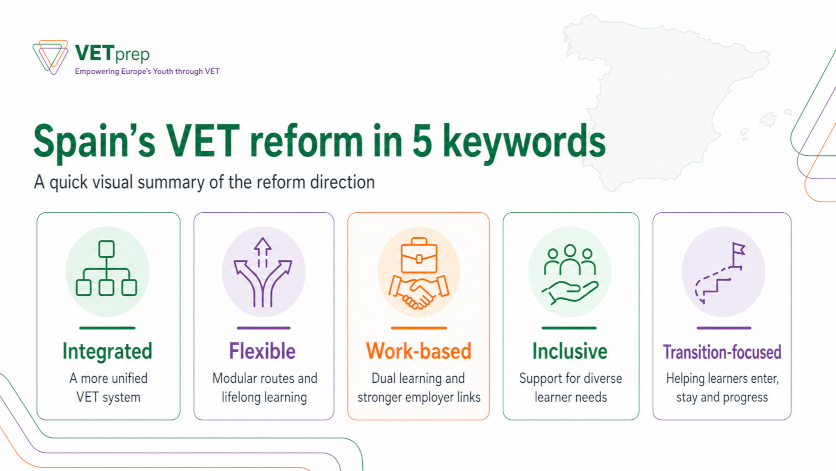
A system moving towards integration
At the same time, the report shows that Spain’s reform framework is being implemented in a system where inequalities remain important. Differences across regions, education centres, and student profiles continue to shape learners’ access to support and opportunities. This is one of the issues VETPrep helps to make visible: the distance that can still exist between an ambitious reform framework and the real-world conditions that affect how fully it can be put into practice.
One of the most important changes in Spain is the move towards a more integrated VET system.
Traditionally, Spanish VET has been organised through two main areas. One is vocational training within the education system, which includes Basic, Intermediate, and Higher VET programmes. The other is vocational training for employment, aimed mainly at employed and unemployed adults who need to reskill or upskill.
The current reform direction seeks to bring these areas closer together. Organic Law 3/2022 is the central reform described in the report. It establishes a single, modular, and flexible national VET system, organised into progressive grades. This means that learning can be built step by step, from smaller units of competence to full qualifications.
This matters because it gives vocational learning a clearer structure. It also supports lifelong learning by making it easier for people to return to training, update their skills, or have previous work experience recognised. In this sense, Spain’s reform is not only about young people entering VET after school. It is also about adults, workers, unemployed people, and learners who need more flexible ways to gain qualifications.
Supporting transition into VET
The VETprep reports focus strongly on transition: how learners move into vocational pathways and how they are supported in making those choices.
In Spain, the first major education choice usually comes at the end of compulsory secondary education, around the age of 16. Students may move towards the academic Bachillerato route or into vocational education. Despite the similar name, Bachillerato is not a Bachelor’s degree. In English terms, it is closer to an academic upper-secondary route, similar to sixth form or A-level preparation, which prepares students for university entrance. In the English terminology used in the report, VET is structured across Basic VET, Intermediate VET, and Higher VET. Basic VET refers to entry-level vocational programmes for students who have not completed compulsory secondary education or are at risk of early school leaving. Intermediate VET is the upper-secondary vocational route leading to a Technician qualification. Higher VET, also referred to in parts of the report as Advanced VET, corresponds to short-cycle tertiary education and leads to an Advanced Technician qualification; it is below a Bachelor’s degree but can provide access to university studies.
Several policies aim to support these transitions. Basic VET plays a compensatory role for learners at risk of early school leaving. Guidance systems, preparatory measures, and employment-oriented programmes also seek to help young people move into education, training, or work.
The report also links transition into VET with wider youth-support policies. One example is the Youth Guarantee Plus Plan, which supports young people aged 16–29 who are outside employment, education, or training. While it is not the main structural VET reform, it complements the reform agenda by offering guidance, training, and employment-related support for young people who may need help finding a route back into education or work.
VET is becoming more visible and more widely used
The report shows that participation in Spanish VET has grown significantly over the last decade. The number of learners in VET programmes increased from around 752,000 in 2014/2015 to more than 1.13 million in 2023/2024. Spain also has more than 4,000 VET institutions, including public and private centres.
The report does not give one single reason for this growth, but it does point to several factors that help explain the trend. One is labour-market demand for technical profiles, especially at intermediate and advanced levels. Another is the effect of national and European investment in VET modernisation, including the expansion of training places, digitalisation, innovation, and stronger links with companies. The growing role of Higher VET is also important: it has expanded strongly and is increasingly positioned as a form of short-cycle higher education that can lead either to employment or to university study.
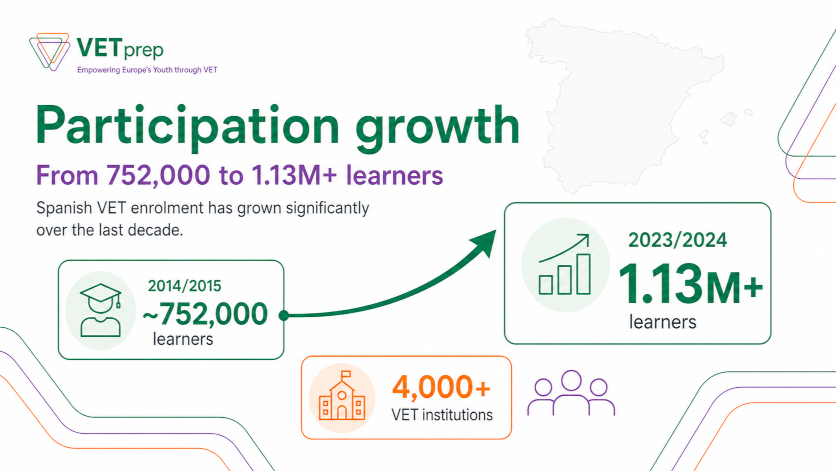
This growth suggests that vocational education is becoming a more important part of the education landscape. Higher VET has expanded especially strongly and increasingly functions as a form of short-cycle higher education. It can lead directly to employment, but it can also provide a route into university studies.
At the same time, growth in enrolment has not removed all older problems. The report is clear that VET in Spain still faces a challenge of public image. Vocational pathways have often been viewed as less prestigious than academic routes, especially university-oriented education. Students from lower socio-economic backgrounds, migrant families, or those with special educational needs are overrepresented in VET, which can reinforce the idea that it is a second-choice pathway.
For this reason, improving the attractiveness of VET is not simply a communications task. It is connected to deeper questions of quality, progression, labour-market outcomes, and social status.
The expansion of dual learning
A major direction of reform is the expansion of “dual VET”. In plain terms, dual VET combines learning in an education centre with learning in a workplace.
Under the current framework, all VET programmes include work-based learning. Spain distinguishes between two dual modalities. In the general modality, learners spend 25–35% of their programme in a company. In the intensive modality, the share of company-based learning is higher than 35%, and the learner has a paid training contract with social security coverage.
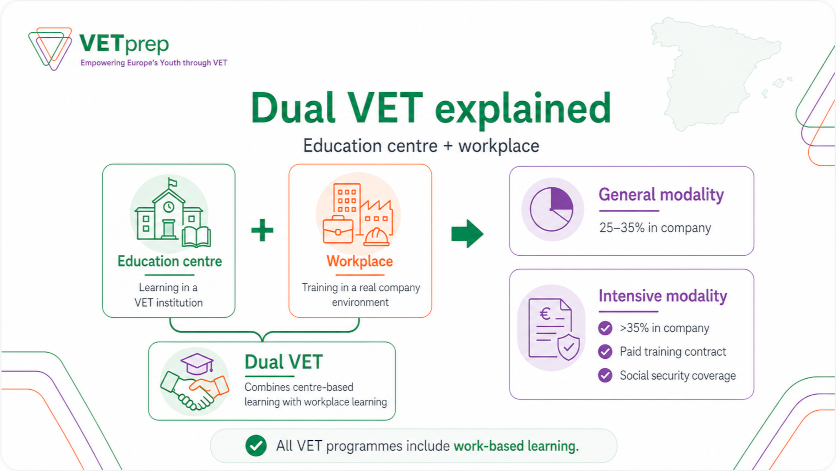
This is a significant shift because the report describes a move away from the traditional Workplace Training Module towards continuous in-company learning throughout the programme. From the 2024/25 academic year, Intermediate and Higher VET programmes are delivered in dual modality from the first year, with workplace learning integrated across the cycle rather than treated mainly as a separate practical placement. The report does not give one single comparable percentage for the previous model, so the safest comparison is qualitative: the new model makes company-based learning earlier, more regular, and more structurally embedded in the curriculum. It also reflects one of the broader goals of Spanish reform: strengthening the link between education and employment.
However, the report also points to implementation challenges. Dual learning depends on the availability and quality of company placements. This can vary across regions, sectors, and types of firms. The report notes that small companies and rural areas may face particular difficulties in sustaining company partnerships. This matters for equity as well as implementation: if work-based learning opportunities are less available or less stable in some territories, learners in already disadvantaged areas may have fewer chances to benefit from the new model. The report also highlights wider territorial disparities in resources, support services, and outcomes, especially affecting rural areas and disadvantaged urban contexts. The quality of the workplace learning experience therefore depends not only on the legal design of dual VET, but also on local employer capacity, cooperation between VET centres and companies, and the preparation of in-company tutors.
So, while dual VET is a key part of the reform direction, its success will depend on consistent implementation and on complementary policies that help equalise opportunities. The report suggests that expanding work-based learning must go together with support for vulnerable learners, stronger guidance, sufficient resources for VET centres, and cooperation with employers across different territories, so that students’ access to high-quality workplace learning does not depend too heavily on where they live or on the local business environment.
More flexible routes through education and work
Another important feature of the Spanish reforms is flexibility.
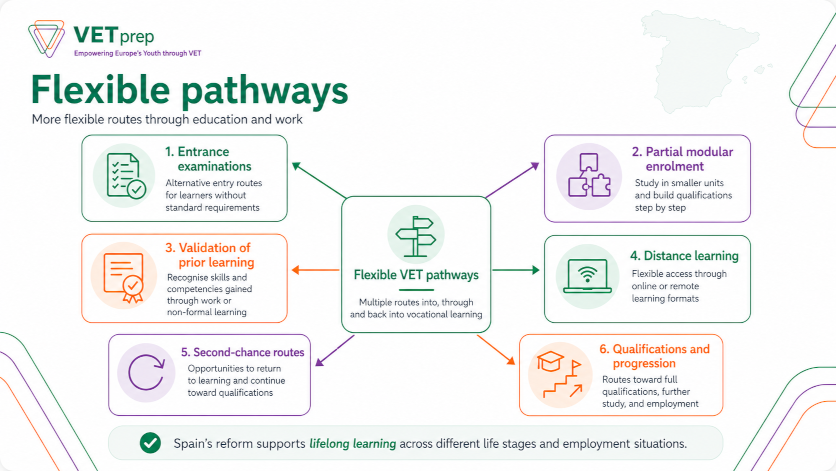
The report describes several mechanisms that allow learners to enter, leave, and return to vocational education in different ways. These include entrance examinations for learners who do not meet standard academic requirements, partial modular enrolment, validation of prior learning, distance learning, and second-chance routes.
This flexibility is especially important in a system that serves very different groups: young people leaving compulsory education, adults seeking new qualifications, unemployed workers, and people whose previous learning took place outside formal education.
The reform direction is therefore not based on a single narrow pathway. Instead, Spain is trying to build a system where vocational learning can support different life stages and employment situations. This is closely linked to the recognition of prior learning, which allows professional competences gained through work or non-formal learning to count towards qualifications.
Participation and dropout prevention
Spain has made progress in reducing early school leaving, but dropout remains a concern, especially in Basic and Intermediate VET. The report notes that dropout in Basic VET exceeds 20% in several regions.
This makes learner support a central part of the reform agenda. The challenge is not only to attract students into vocational education, but also to help them stay, progress, and complete their programmes.
PROA+ is one of the key measures discussed in the report. It is not a VET-specific programme. Rather, the report presents it mainly as a school-based support programme for education centres with high levels of educational vulnerability, especially in compulsory education. It works through mentoring, tutoring, guidance, and cooperation with families. Its relevance to VET lies in prevention: by improving attendance, school climate, and learner support earlier in the education pathway, it may help students reach vocational options better prepared.
The report also highlights the importance of inclusion. While the perception of VET is improving and vocational pathways are becoming more attractive, important inequalities remain in who enters different parts of the system. Students of migrant origin, learners from more vulnerable socio-economic backgrounds, and students with specific educational support needs continue to be overrepresented in VET, especially in certain modalities and education levels. VET is therefore increasingly understood in Spain as a route for learners who have faced educational disadvantage, including learners who may need additional academic, social, or institutional support. The number of VET students with specific educational support needs has grown substantially over the past decade: according to the report, it increased from 12,046 learners in 2014/2015 to 55,757 in 2023/2024. Most of these learners were enrolled in Basic VET and Intermediate VET, with 15,804 in Basic VET, 27,856 in Intermediate VET, and 12,097 in Higher VET in 2023/2024.
Yet inclusion remains uneven. The challenges do not depend only on the formal education framework. Some centres lack enough specialised staff, guidance professionals, or teacher preparation to provide sustained individual support. Regional disparities, the availability of specialised resources, access to work-based training opportunities, and the characteristics of the local business community can all shape how inclusion policies work in practice. These are precisely the kinds of real-world implementation conditions that VETPrep’s later work, including WP5, can help examine more closely.
A strong reform framework, but implementation remains the test
The overall picture is of a country that has created a strong legal and policy framework for modernising VET. Organic Law 3/2022, the VET Modernisation Plan, the expansion of dual learning, PROA+, Youth Guarantee Plus, and earlier employment activation measures together form a broad reform agenda.
The direction is clear. Spain is trying to make VET more coherent, more modular, more work-based, more inclusive, and more connected to lifelong learning.
But the report is also careful not to present reform as already complete. Several limits remain. There is not yet comprehensive outcome-based evaluation of the main structural reforms. Much of the available evidence focuses on implementation, investment, or early outputs rather than long-term effects on completion, employability, or the public image of VET. Regional differences continue to shape access, quality, and workplace-learning opportunities. Some investment also depends on temporary European funding, raising questions about sustainability.
Why Spain matters for the wider VET debate
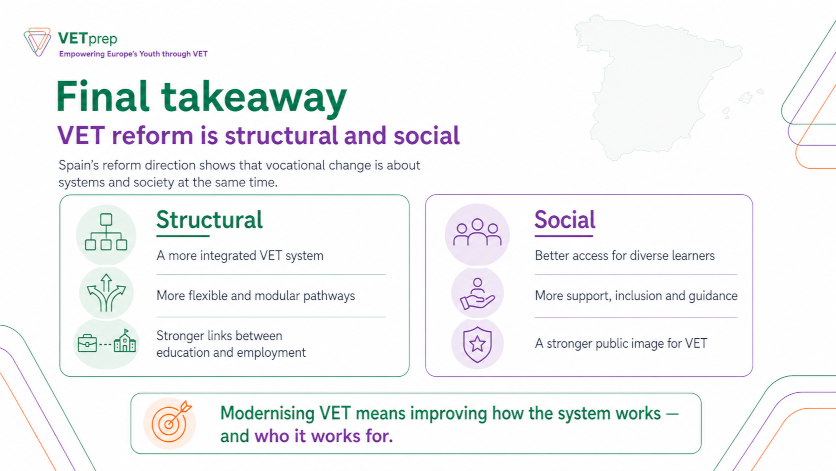
Spain’s current direction shows how vocational reform can be both structural and social. It is structural because it changes the organisation of the system, the relationship between education and employment, and the way qualifications are built. It is social because it aims to improve access, support vulnerable learners, reduce dropout, and make vocational pathways more valued.
For the VETprep project, Spain offers a useful example of a system trying to address several questions at once: how to make VET more attractive, how to support transitions into vocational learning, and how to help students remain and succeed once they enter.
The Spanish case also shows that modernising VET is not a single reform. It is a long process involving legislation, funding, guidance, workplace partnerships, teacher capacity, learner support, public perception, and wider social engagement. This means that society needs to be involved at several structural levels, for example through coordination spaces or committees that bring together education providers, companies, families, young people, youth associations, and other relevant community actors. The foundations are now in place. The next challenge is to ensure that these reforms produce consistent benefits for learners across regions, sectors, and social groups. This is where VETPrep’s comparative work can add value: by examining how countries address attractiveness, transition, participation, and dropout prevention, the project can help identify which approaches are most useful for supporting learners and where further policy attention may be needed. This includes looking beyond participation figures alone, towards whether reforms lead to better education, work, and social trajectories for different student profiles.